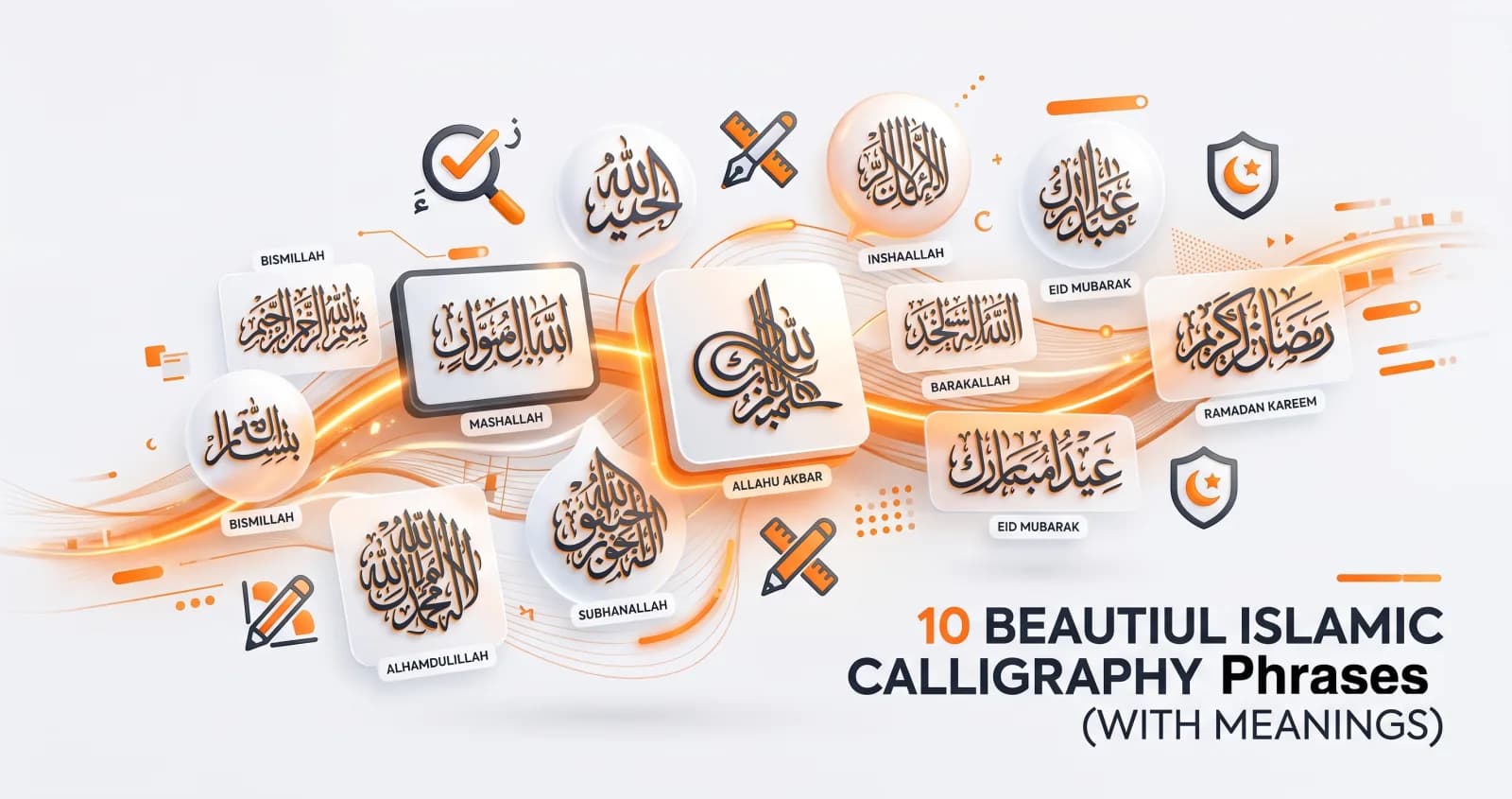
Some Arabic phrases are so meaningful and so beautiful that they've become art forms in their own right. They appear on walls, jewellery, greeting cards, and digital designs around the world. Here are ten of the most beloved Islamic phrases, with their Arabic script, transliteration, and meaning — plus guidance on using them respectfully and turning them into calligraphy.
1. Bismillah
بِسْمِ اللَّهِ الرَّحْمَٰنِ الرَّحِيمِ — Bismillāhi r-Raḥmāni r-Raḥīm
"In the name of God, the Most Gracious, the Most Merciful." The opening of all but one chapter of the Qur'an, and the phrase Muslims say before beginning any task — eating, travelling, starting work. It is the single most popular phrase in Islamic calligraphy, and has been for a thousand years.
Design note: the full form is long. It works beautifully across a wide horizontal composition or split across two lines, but it will look cramped in a square. The shorter بِسْمِ اللَّهِ (Bismillah) alone is a better fit for small formats.
2. MashaAllah
مَا شَاءَ اللَّهُ — Mā shāʾ Allāh
"What God has willed." Said to express joy, appreciation and gratitude — often when admiring something beautiful, and traditionally to ward off the evil eye when praising a person, a child or a possession.
Design note: short and balanced, with a pleasing rhythm of ascenders. One of the easiest phrases to set well, and a good first project.
3. Alhamdulillah
الْحَمْدُ لِلَّهِ — Al-ḥamdu lillāh
"All praise is due to God." An expression of thankfulness used countless times a day — after eating, after good news, after recovering from illness, and as a standard answer to "how are you?"
Design note: the doubled lām in لِلَّهِ carries a shadda, and cheap fonts sometimes render it poorly. Check it at large size before exporting.
4. SubhanAllah
سُبْحَانَ اللَّهِ — Subḥān Allāh
"Glory be to God." Said in awe and wonder, especially at the beauty of creation — a landscape, a night sky, a newborn.
Design note: the long horizontal of the sīn (س) gives this phrase a strong baseline. It suits Kufic unusually well for a vocalised phrase.
5. Allahu Akbar
اللَّهُ أَكْبَرُ — Allāhu akbar
"God is the greatest." A declaration of God's supremacy, central to the call to prayer (adhan) and repeated throughout the prayer itself. The comparative form is deliberate: greater than anything that could be named.
6. La ilaha illa Allah
لَا إِلَٰهَ إِلَّا اللَّهُ — Lā ilāha illā Allāh
"There is no god but God." The first half of the shahada, the Islamic declaration of faith. Along with Bismillah, it is the phrase most often rendered as monumental calligraphy in mosques.
Design note: contains several lām-alif ligatures (لا), which is a good test of a font's quality — if they render as two separate letters rather than a single joined form, the font is broken. Every hand in the studio handles it correctly.
7. InshaAllah
إِنْ شَاءَ اللَّهُ — In shāʾ Allāh
"If God wills." Said when speaking of any future plan, acknowledging that outcomes rest with God rather than with the speaker.
Note on spelling: it is three words — إِنْ شَاءَ اللَّهُ — and the common one-word rendering "inshallah" is a colloquial compression. For calligraphy, use the correct three-word form.
8. Barakallah
بَارَكَ اللَّهُ — Bāraka Allāh
"May God bless." Usually extended to Bārakallāhu fīk (بَارَكَ اللَّهُ فِيكَ), "may God bless you," used to thank or congratulate. A natural fit for gifts, cards and wedding stationery.
9. Eid Mubarak
عِيدٌ مُبَارَكٌ — ʿĪd Mubārak
"Blessed celebration." The festive greeting exchanged during Eid al-Fitr and Eid al-Adha. Perfect for cards and seasonal designs — see our Eid and wedding ideas.
Design note: both words carry tanwin (the doubled damma, ـٌ). It's grammatically correct and worth keeping, but it needs vertical clearance — raise the line height.
10. Ramadan Kareem
رَمَضَانُ كَرِيمٌ — Ramaḍān Karīm
"Generous Ramadan." A warm greeting for the holy month, popular on banners, social posts and gifts. You will also see رَمَضَانُ مُبَارَكٌ (Ramadan Mubarak, "blessed Ramadan"), which some prefer on the grounds that generosity is an attribute of people rather than of a month. Both are in wide use.
Using sacred text respectfully
These are religious phrases, and several are direct Qur'anic text. A few conventions are worth observing — not as rules imposed on you, but because getting them wrong is the thing most likely to cause offence to the audience you're designing for.
- Accuracy is not optional. A misplaced diacritic can change a word. Use fully vocalised text from a reliable source rather than transcribing by hand. Every phrase above is correctly vocalised, and the ready-made phrase buttons in the studio drop them in exactly as written here.
- Don't distort the letters past legibility. Stretching, warping or fragmenting the name of God for a visual effect is widely considered disrespectful. Stylise freely; don't deform.
- Think about the object. Sacred text is conventionally kept off things that get walked on, sat on, or thrown away — floor mats, shoes, doormats, disposable packaging. Wall art, cards, jewellery and clothing are all normal and uncontroversial.
- Be careful with placement on the body. Practice varies considerably, and if you're designing for someone else it's worth asking rather than assuming.
- Avoid mixing it with unrelated imagery. Sacred phrases combined with commercial or promotional graphics tend to land badly.
If you are designing for a client or a community rather than for yourself, showing the draft to a fluent reader before you print is always worth the five minutes.
How to turn these phrases into art
Each of these looks stunning in calligraphy, and the style changes the whole mood:
- Diwani or a Thuluth-like hand for ornate, traditional wall art. Aref Ruqaa comes closest in the studio.
- Kufic for a bold, modern, geometric statement — best on the shorter phrases.
- Naskh for clear, classic legibility. Amiri is the right default for any full Qur'anic verse.
Because these are religious phrases, use full harakat so the vocalisation is correct — here's our guide to harakat — and choose a font with strong diacritic support. Amiri and Scheherazade are the two safe choices; Rakkas and Lalezar have almost no clearance above the letters and will crush the marks. Our best Arabic fonts guide rates each one.
Two practical settings that make the difference:
- Line height 1.6–1.8. Vocalised text needs the room. At default spacing the marks from one line collide with the letters of the next.
- Large font size. Diacritics don't scale down gracefully. If the marks look cramped, increase the size rather than adjusting the spacing.
Choosing a format
- Square (1080×1080) — social posts and framed prints.
- Portrait (1000×1500) — the best choice for wall art and anything you'll print. Also suits multi-line verses.
- Wide (1500×500) — banners and profile headers. Only works for short phrases in a compact hand.
Create your own in seconds
Open the Arabic calligraphy generator, tap any phrase above from the ready-made list, pick a style, and export it as wall art, a card, or a social post. Everything renders in your browser, so nothing you type is uploaded anywhere.
You can also animate a phrase like Bismillah into a calligraphy video that writes itself on screen — the Rewrite effect draws right to left, in the direction the script is actually written, which suits sacred text far better than a zoom or a bounce.