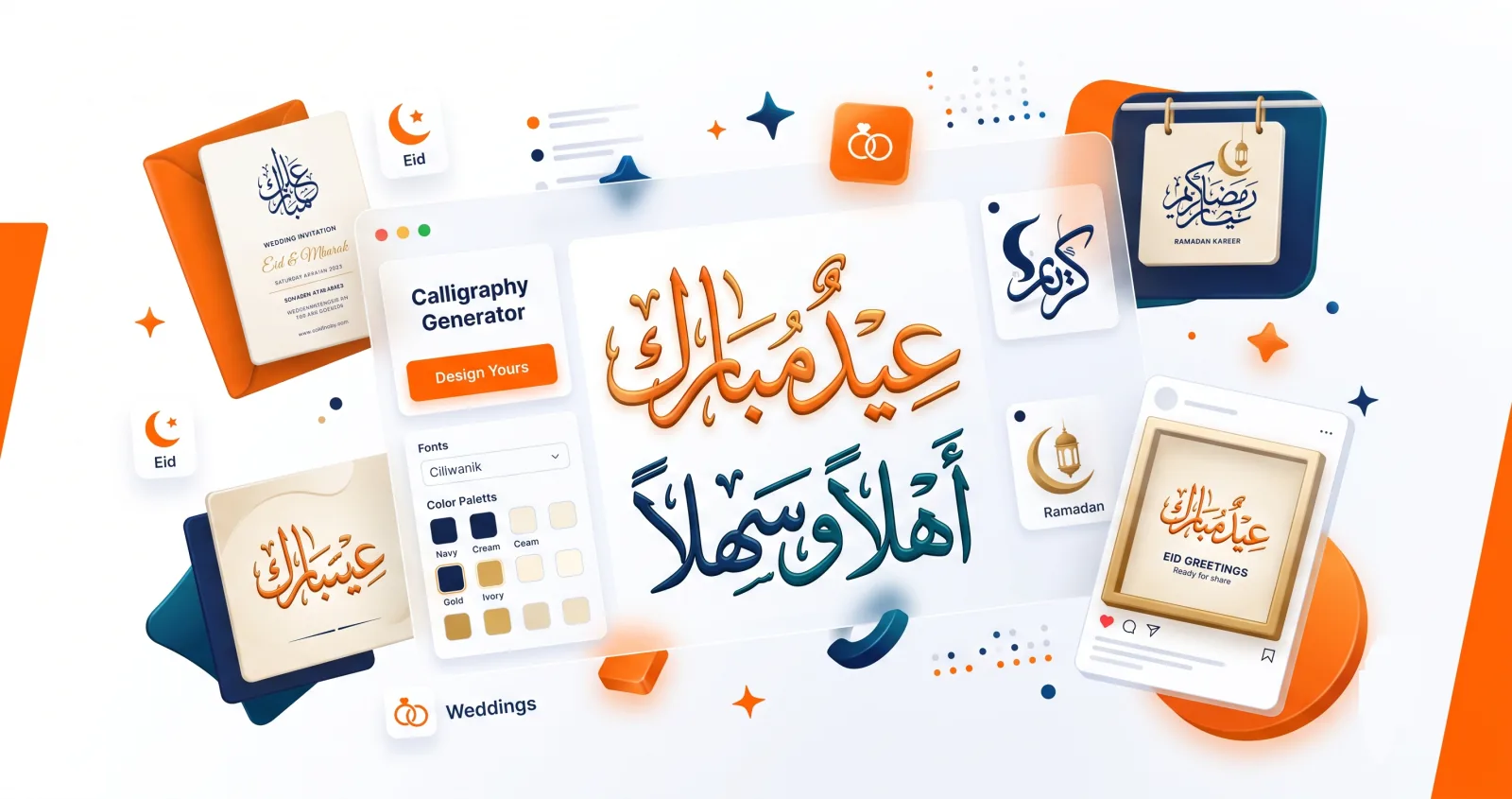
Celebrations are where Arabic calligraphy shines brightest. Weddings, Eid and Ramadan all carry deep cultural meaning, and elegant lettering adds beauty and a personal touch to every part of the occasion. Here are ideas for using calligraphy in your celebrations — plus the print specifications that keep them from arriving blurry.
Wedding calligraphy ideas
A wedding is full of opportunities for beautiful Arabic lettering.
Stationery
- Save-the-dates and invitations. Set the couple's names and the date in a flowing Diwani or graceful Nastaliq for an instantly elegant invite.
- RSVP and detail cards. Keep these in a quieter hand — Naskh or a modern face — so the invitation itself stays the hero.
- Menus and programmes. Calligraphic headings over a clean body text is the pairing that works.
- Thank-you cards. A handwritten-feeling Shukran (شُكْراً) makes favours feel personal.
On the day
- Welcome signs. A large Ahlan wa Sahlan (أهلاً وسهلاً — "welcome") greets guests at the entrance. This is the piece guests photograph, so give it the most attention.
- Table names and place cards. Replace table numbers with calligraphic names of cities, flowers, or words that mean something to the couple.
- Seating charts and directional signs. Consistency matters more than ornament here — use the same hand as the invitation.
- A couple's monogram. Combine both names into a single calligraphic mark used across stationery, signage and gifts. See how to turn names into calligraphy.
Digital
For a modern celebration, an animated version of the couple's names — calligraphy that writes itself — makes a memorable detail on a wedding website, an invitation video, or a story announcement. Here's how to animate calligraphy.
Phrases for weddings
- بَارَكَ اللَّهُ لَكُمَا — Bārakallāhu lakumā, "may God bless you both." The traditional congratulation.
- أهلاً وسهلاً — Ahlan wa sahlan, "welcome."
- مَبْرُوك — Mabrūk, "congratulations."
- بِالرَّفَاءِ وَالبَنِين — Bi-r-rafāʾi wa-l-banīn, a classical wedding blessing.
Eid calligraphy ideas
Eid al-Fitr and Eid al-Adha are perfect occasions for festive lettering:
- Greeting cards featuring Eid Mubarak (عِيدٌ مُبَارَكٌ — "blessed celebration").
- Social media posts to send greetings to friends and followers — the Square preset is right for a feed post, Story for a vertical share.
- Gift tags and wrapping with short blessings.
- Home banners and decor to mark the festivities.
- Kids' Eid money envelopes (eidiyah), an easy print-at-home project.
You'll find Eid Mubarak and other greetings in our collection of Islamic phrases, correctly vocalised and ready to drop into a design.
Ramadan calligraphy ideas
The holy month invites warm, reflective designs:
- Ramadan Kareem (رَمَضَانُ كَرِيمٌ) banners and lanterns.
- A printable iftar table sign or a countdown chart.
- Daily reminder posts with short phrases like Alhamdulillah — a set of thirty is a genuinely useful content series.
- Decor pairing calligraphy with the crescent and lantern motifs of the season.
- Suhoor and iftar timing cards for the household.
How to make your own
You don't need a designer or a calligrapher:
- Open the Arabic calligraphy generator and type your phrase or names.
- Choose a style to match the mood — Diwani and Nastaliq for romance and elegance, Kufic for a bold modern look. Our styles guide can help you decide.
- Pick colours that match your palette.
- Use a transparent background so you can place the text over photos, patterns or coloured card.
- Export a high-resolution PNG for print, or a JPG for screens.
Colour palettes that work
- Gold on ivory — the classic wedding combination. Warm, formal, and it prints well on textured stock.
- Deep green and gold — strongly associated with Eid and Ramadan.
- Navy or charcoal on cream — modern and restrained, good when the calligraphy is doing the decorative work alone.
- Terracotta, sage and warm neutrals — the contemporary palette for outdoor and garden celebrations.
- White on deep jewel tones — dramatic for evening events and Ramadan night decor.
One caution: gold and other metallic tones that look luxurious on a bright screen can lose all contrast in print or on a phone in daylight. Keep real luminance difference between ink and ground for anything that carries information — names, dates, addresses.
Preparing files for print
This is where most home-made celebration stationery goes wrong.
- Design at the final size or larger. The Portrait preset (1000×1500) is the right starting point for invitations, prints and signs. Raster images can't be enlarged after the fact without softening.
- Understand what your resolution buys you. A 1000×1500 export prints crisply at around A6–A5. For an A4 sign or larger, use the biggest preset available and keep the type large rather than scaling the file up afterwards.
- Add a margin. Commercial printers trim, and anything within a few millimetres of the edge is at risk. Keep text well inside the frame.
- Export PNG, not JPG, for anything with a transparent ground — JPG has no alpha channel and will fill the background for you.
- Order a single proof first. Print one before you print a hundred. Colours shift between screen and paper, and fine strokes can thicken on absorbent stock.
- Consider the paper. Delicate Diwani hairlines disappear on heavily textured or uncoated card. If you want texture, choose a heavier hand.
Tips for celebration designs
- Match the script to the occasion. Ornate for weddings, festive and clear for Eid, warm and calm for Ramadan.
- Stay consistent. Use the same font and colour across invites, signs and favours. Consistency reads as "designed"; variety reads as "assembled."
- Check the spelling of every name before printing, especially transliterated ones. Our name guide covers the pitfalls.
- Verify dates and times separately. Arabic-Indic numerals (٠١٢٣٤٥٦٧٨٩) and Western ones both appear in Arabic materials — pick one and use it everywhere.
- Give harakat room. If your phrase is fully vocalised, raise the line height to 1.6 or above so the marks don't collide. See the harakat guide.
- Start early. Printing, proofing and reprinting takes longer than you think, and the proof almost always reveals something.
Whatever you're celebrating, a touch of Arabic calligraphy turns the ordinary into the memorable. Start designing your celebration pieces →